

Hannah Arendt
Special Edition Magazine
Celebrating the life and ideas of Hannah Arendt
(1906-1975)
Submission window CLOSED.
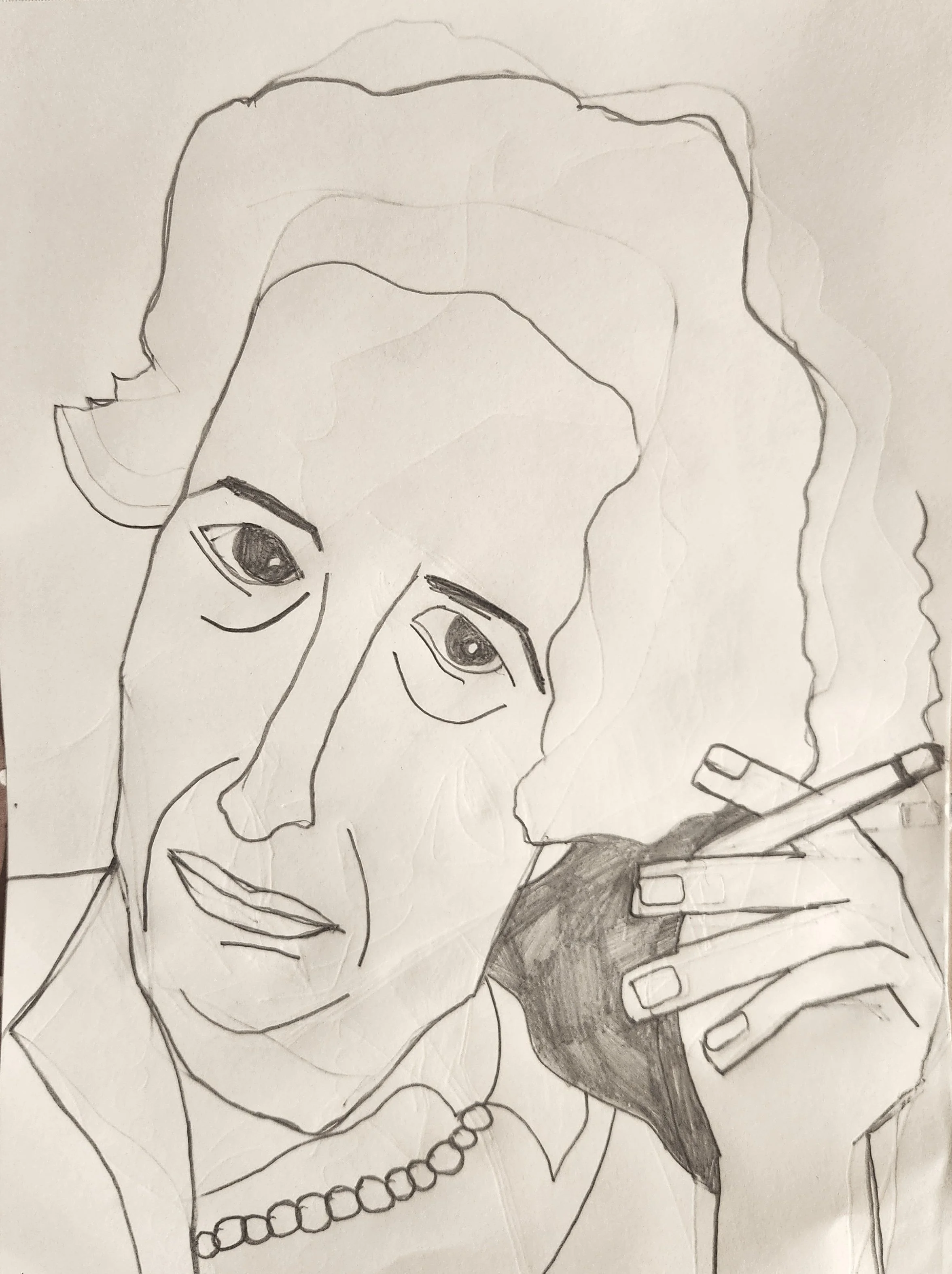
Hannah Arendt by Tom Block

The International Human Rights Art Movement was thrilled to receive a National Endowment of the Arts grant to produce work around the American hero Hannah Arendt (as designated by Donald Trump, Executive Order 13978, January 18, 2021). She was chosen as one of 244 heroes from American history to be so honored.
As part of this work, we are issuing a call for literary submissions to honor the life and work of this American hero, German-Jewish refugee and one of the seminal political philosophers of the 20th century. As she noted: “Events, deeds, and words … would hardly survive … if they were not preserved … ‘woven into stories.’” And so we ask you to weave Hannah Arendt’s life and ideas into story.
Specifically, we are looking for writing (poetry; short stories, 2500 words or less; and essays, 2500 words or less) along the following themes, which defined some of her most important ideas. You may agree, disagree or opine as you like - it is about the conversation!
Banality of Evil: Arendt asserts that great evils can be perpetrated not by fanatics or monsters, but by ordinary people who are thoughtless and complacent, simply following orders and conforming to the systems they are part of. The concept suggests that evil can be a result of a failure to think critically and empathize with others, allowing injustice to become a matter of routine, bureaucratic procedure. “The transformation of the family man from a responsible member of society, to a ‘bourgeois’ concerned only with his private existence and knowing no civic virtue, is an international modern phenomenon. The exigencies of our time can at any moment transform him into the mob man and make him the instrument of whatsoever madness and horror.”
Refugees: “The calamity of the right-less [refugee] is not that they are deprived of life, liberty, and the pursuit of happiness, or of equality before the law and freedom of opinion—formulas which were designed to solve problems within given communities—but that they no longer belong to any community whatsoever. Their plight is not that they are not equal before the law, but that no law exists for them.”
Human Rights: “The Rights of Man had been defined as ‘inalienable’ because they are supposed to be independent of all governments; but it turns out that the moment human beings lack their own government and have to fall back on their minimum rights, no authority is left to protect them and no institution is willing to guarantee them.”
Totalitarianism: “Masses are attracted by every effort which seems to promise a man-made fabrication of the Paradise they had longed for and of the Hell they had feared. The stability of the totalitarian regime depends on the isolation of this fictitious world of the movement from the outside world.”
Truth: “Factual truth, ignores it happens to oppose a given group’s profit or pleasure, is greeted today with greater hostility than ever before . . . Throughout history, the truth-seekers and truth-tellers have been aware of the risks of their business: as long as they did not interfere with the course of the world, they were covered with ridicule, but he who forced his fellow citizens to take him seriously by trying to set them free from falsehood and illusion was in danger of their life.”
Truth and Politics: “No one has ever doubted that truth and politics are on rather bad terms with each other and no one, as far as I know, has ever counted truthfulness among the political virtues . . . Seen from the viewpoint of politics, truth has a despotic character. It is therefore hated by tyrants, who rightly fear the competition of a coercive force they cannot monopolize, and it enjoys a rather precarious status in the eyes of governments that rest on consent and abhor coercion.”
Free Will: “When there is no possibility of resistance, there exists the possibility of doing nothing . . . It is this possibility of non-participation that is decisive if we begin to judge, not the system, but the individual.”
Human Nature: “Human's 'nature' is only 'human' insofar as it opens up to [a person] the possibility of becoming something highly unnatural, that is, a human . . . It is quite conceivable, and even within the realm of practical political possibilities, that one fine day a highly organized and mechanized humanity will conclude quite democratically—namely by majority decision—that for humanity as a whole it would be better to liquidate certain parts thereof.”
Discrimination/Segregation: Arendt had controversial ideas around the discrimination and segregation that she saw in the United States. While she was passionate in her belief that the political and private spheres should remain fiercely egalitarian - from the right to marry who you like to the right to sit where you want and have access to all public spheres - she was against forced school desegregation, as well as for the right of private clubs to exclude “others” from their midst (all-Jewish dining clubs; all Christian country clubs, all-Black book clubs etc.). “Discrimination is as indispensable a social right as equality is a political right. The question is not how to abolish discrimination, but how to keep it confined within the social sphere, where it is legitimate, and prevent its trespassing on the political and personal sphere, where it is destructive.” To learn more about her ideas on discrimination and segregation, please visit THIS PAGE.
Biography: Hannah Arendt was born into a German-Jewish family, was forced to leave Germany in 1933, and lived in Paris for the next eight years, working for a number of Jewish refugee organizations. In 1941 she immigrated to the United States and soon became part of a lively intellectual circle in New York. She held a number of academic positions at various American universities until her death in 1975. More biographical information HERE.
Submission Guidelines
Poetry (up to 3 poems per author),
Short-stories (up to 2,500 words),
Personal essays (up to 2,500 words)
Please submit your poetry, short story and/or essay to hello@humanrightsartmovement.org along with the following required information:
Your full name and/or pen name.
Your country of residence.
A brief third-person bio (roughly 100 words). If your bio includes references of your past work, feel free to provide links!
A brief foreword to your piece (between 300-500 words), explaining your inspiration for creating it, background information, explanation of key characters, and any other key insight for the reader.
*If your piece is accepted, we will request a high-resolution author photograph. However, authors are not required to provide photographs of themselves and are always welcome to decline, should they wish to remain anonymous.
All accepted writers will receive $50, regardless of how many of their pieces are included in this special edition folio.
For further information on Hannah Arendt,
please visit the
Hannah Arendt Center at Bard College